Strange finds and forgotten stories
Nine true stories from Stone Age Britain, each checked against a museum, a heritage body or a published study. Where something is a guess, we say so.
Jump to: The Red Lady who was not a lady | Footprints nearly a million years old, gone in a fortnight | Britain’s Ice Age cave art, found in 2003 | A path across a swamp, built in one winter nearly 6,000 years ago | The six-tonne stone that came from Scotland | The Amesbury Archer, who grew up near the Alps | The chalk drums that were never drums | Skara Brae used to be inland | The man who bought Stonehenge
The Red Lady who was not a lady
In 1823 William Buckland, Oxford University’s first Reader in Geology, found a partial human skeleton stained with red ochre in Goat’s Hole Cave, also called Paviland Cave, on the Gower in South Wales. Shell beads and carved ivory lay with it. Oxford University Museum of Natural History: The ‘Red Lady’ of Paviland · checked 19 Nov 2026
Because of the ornaments, Buckland decided the bones were a woman’s, and assumed she was from the Roman period, about 2,000 years ago. Oxford University Museum of Natural History: The ‘Red Lady’ of Paviland · checked 19 Nov 2026 He suggested she was a Roman-era prostitute connected to a military garrison. Geological Society: William Buckland and the Red Lady of Paviland
Both guesses were wrong. The bones are a young man’s, and in 2008 improved radiocarbon dating put them at around 33,000 to 34,000 years old. That makes the “Red Lady” one of the oldest examples of a ceremonial burial in Western Europe. Oxford University Museum of Natural History: The ‘Red Lady’ of Paviland · checked 19 Nov 2026 The ivory was not elephant but mammoth tusk. Geological Society: William Buckland and the Red Lady of Paviland
Where to see it: The bones are held by the Oxford University Museum of Natural History.
In one line: Britain’s most famous Ice Age “lady” is a young man, and the “Roman” is about 33,000 years old.
Footprints nearly a million years old, gone in a fortnight
In May 2013 the sea stripped back the beach at Happisburgh in Norfolk and exposed a surface of ancient silt with a series of hollows across about 12 square metres. Ashton et al., Hominin footprints from Early Pleistocene deposits at Happisburgh, PLOS ONE (2014)
They were footprints: the oldest known hominin footprint surface outside Africa, dated to between about 1 million and 780,000 years ago. In one case the impression of toes can be seen. Ashton et al., Hominin footprints from Early Pleistocene deposits at Happisburgh, PLOS ONE (2014) The print lengths vary from about 140 to 260 mm, made by several people of different ages, possibly five individuals. Ashton et al., Hominin footprints from Early Pleistocene deposits at Happisburgh, PLOS ONE (2014)
The team had only about two weeks to record them, using multi-image photogrammetry and laser scanning. The tides wore the prints away, and they were completely gone by the end of May 2013. Ashton et al., Hominin footprints from Early Pleistocene deposits at Happisburgh, PLOS ONE (2014)
Where to see it: The prints survive only as 3D records and photographs; the surface itself was washed away.
In one line: The oldest human footprints outside Africa were found in Norfolk, and the sea took them back within weeks.
Britain’s Ice Age cave art, found in 2003
Ice Age cave art had been known in Europe since at least the 19th century, but none had been found in Britain. On 14 April 2003 Paul Bahn, Paul Pettitt and Sergio Ripoll went looking at Creswell Crags, on the Nottinghamshire–Derbyshire border. Creswell Crags: Twenty years since the rock art discovery · checked 19 Nov 2026
The head ranger, Brian Chambers, pointed them to Church Hole, on the Nottinghamshire side of the gorge. There they found engravings including a red deer stag and figures read variously as birds or women. Creswell Crags: Twenty years since the rock art discovery · checked 19 Nov 2026
The art is engraved, not painted, so it could not be radiocarbon dated. Instead, scientists dated thin limestone crusts that had formed over the engravings. The crusts are about 12,800 years old, so the art must be older, which makes it the oldest known rock art in Britain. University of Bristol: Creswell rock art dated (22 April 2005)
Where to see it: Creswell Crags is a gorge with caves, a museum and a visitor centre; check its own site for cave visits.
In one line: Britain does have Ice Age cave art: engravings at Creswell Crags, older than 12,800 years.
A path across a swamp, built in one winter nearly 6,000 years ago
The Sweet Track is a very early Neolithic walkway of single planks, raised across almost 2 km of reed swamp in the Somerset Levels, between the Polden hills and the island of Westhay. Historic England: The Sweet Track and climate change
Several of its oak and ash planks still have their last growth rings, so tree-ring dating can say not just the year but the season they were felled: the winter of 3807/3806 BC or early spring 3806 BC. Repairs went on until at least 3800 BC. Historic England: The Sweet Track and climate change
It was built in parts: planks of oak, ash and lime, with rails and pegs mainly of hazel and alder. The pieces were prepared on dry land, carried into the wet, then pegged and wedged into place. British Museum: plank from the Sweet Track · checked 19 Nov 2026
Where to see it: The British Museum holds a plank from the Sweet Track.
In one line: Thanks to tree rings, we know a Neolithic footpath in Somerset was built in the winter of 3807/3806 BC.
The six-tonne stone that came from Scotland
The Altar Stone is the large sandstone block lying at the centre of Stonehenge. For years it was thought to come from Wales. In 2024 a team led by Curtin University studied the age and chemistry of tiny mineral grains in fragments of it. Curtin University: Stonehenge’s Altar Stone origins (August 2024)
The grains match the Old Red Sandstone of the Orcadian Basin in north-east Scotland. That means the 6-tonne block was brought at least 750 km to Salisbury Plain; the researchers think it probably went by sea. Clarke et al., A Scottish provenance for the Altar Stone of Stonehenge, Nature (14 August 2024)
For comparison, the paper notes that the bluestones were brought around 225 km from Mynydd Preseli in Wales. Clarke et al., A Scottish provenance for the Altar Stone of Stonehenge, Nature (14 August 2024)
Where to see it: The Altar Stone lies at the centre of Stonehenge, under fallen stones.
In one line: Stonehenge’s central Altar Stone came from north-east Scotland, at least 750 km away.
The Amesbury Archer, who grew up near the Alps
In May 2002, three miles from Stonehenge, Wessex Archaeology found the grave of a man who died around 2300 BC. It is the richest grave of its time ever found in Britain, with about 100 objects: three copper knives, two gold hair ornaments, two stone wristguards, flint arrowheads and five pots. Wessex Archaeology: The Amesbury Archer
His gold is among the earliest found in Britain. Tests on his tooth enamel show he grew up in central Europe, most likely the Alps region. Wessex Archaeology: The Amesbury Archer
He was 35 to 45 years old and had a bad limp, as his left kneecap was missing. A cushion stone in the grave suggests he was a metalworker, not just an archer. The Salisbury Museum: Amesbury Archer · checked 19 Nov 2026
Where to see it: The Salisbury Museum displays the Amesbury Archer and his grave goods.
In one line: A man buried near Stonehenge around 2300 BC with some of Britain’s first gold grew up near the Alps.
The chalk drums that were never drums
The Folkton drums are three barrel-shaped cylinders of solid chalk, carved with patterns, found with the burial of a single child in North Yorkshire and excavated in 1889. They have been in the British Museum ever since. British Museum press release: the Burton Agnes drum (February 2022)
In 2015 a near-identical chalk “drum” was found near Burton Agnes in East Yorkshire, about 15 miles away, with the burial of three children. A radiocarbon date from one of the children dates that burial to 3005–2890 BC, about 500 years older than the guess for the Folkton drums. British Museum press release: the Burton Agnes drum (February 2022)
Despite the name, they are not thought to have been musical instruments. The British Museum describes them as works of sculpture, perhaps talismans to protect the children they were buried with. British Museum press release: the Burton Agnes drum (February 2022)
Where to see it: The Folkton drums are in the British Museum’s collection.
In one line: Britain’s famous Stone Age “drums” are solid chalk and were never played.
Skara Brae used to be inland
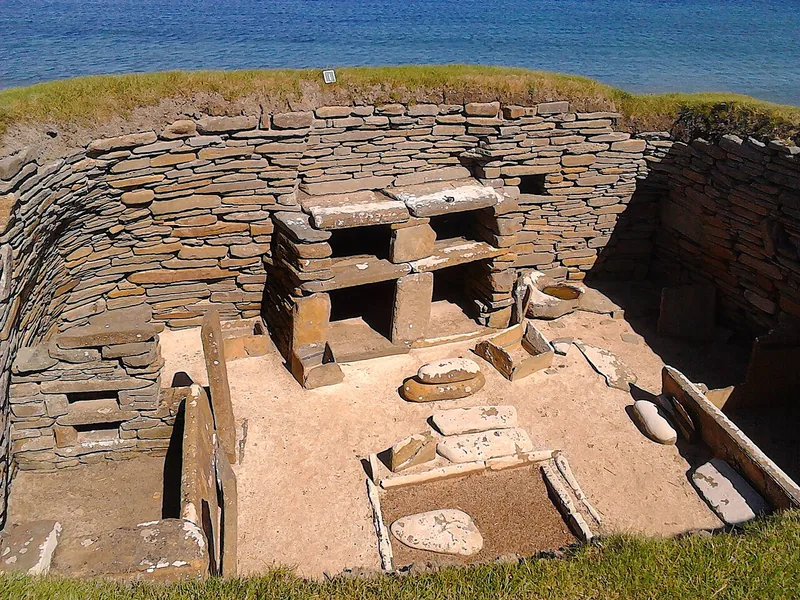
Today Skara Brae sits on the shore of the Bay of Skaill in Orkney. When people lived there, it was an inland village beside a freshwater loch. Historic Environment Scotland: Skara Brae, history
The finds there include gaming dice, tools, pottery, jewellery and carved stone objects, perhaps used in rituals. No weapons have been found. Historic Environment Scotland: Skara Brae, history
No one knows why village life ended around 2500 BC. Some argue a huge sandstorm covered the houses, and others think it was a slower change. Historic Environment Scotland: Skara Brae, history
Where to see it: Most finds are shown in the Skara Brae visitor centre.
In one line: Skara Brae is now by the sea, but its builders lived beside a freshwater loch, and they played dice.
The man who bought Stonehenge
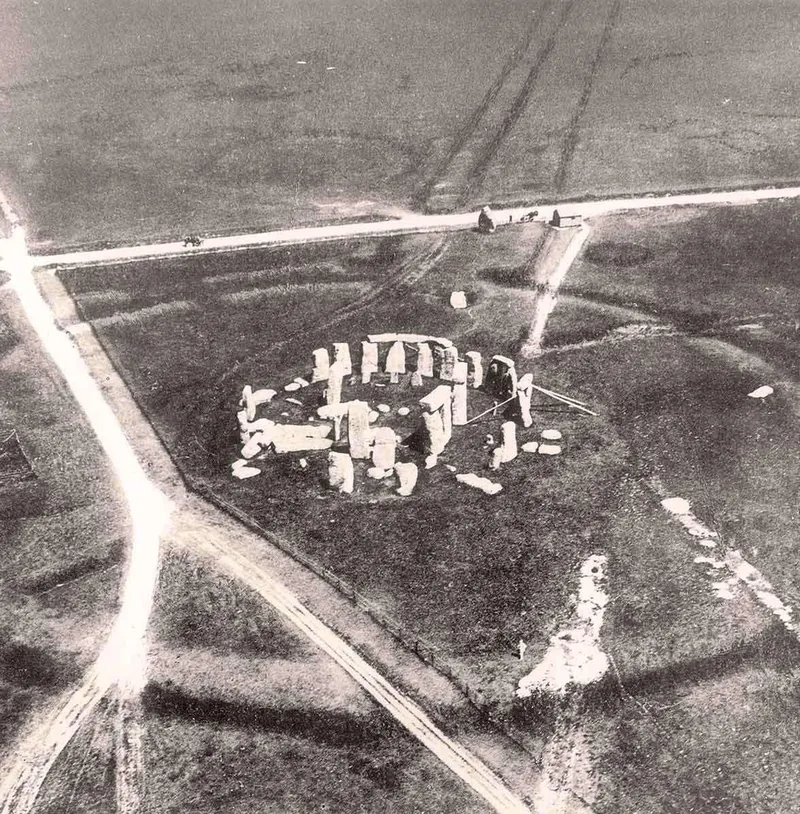
Stonehenge was in private hands until 1918. Cecil Chubb, a local man, had bought it from the Antrobus family at an auction three years earlier, and in 1918 he gave it to the nation. English Heritage: History of Stonehenge
From then on, looking after the monument was the state’s job, done today by English Heritage. From 1927 the National Trust began to buy up the land around it. English Heritage: History of Stonehenge
Where to see it: Stonehenge is run by English Heritage; check its site before you visit.
In one line: Stonehenge was once bought at auction, and the buyer gave it away three years later.
More on the places in these stories: Stone Age places in Britain, Myths vs facts and the big facts page.